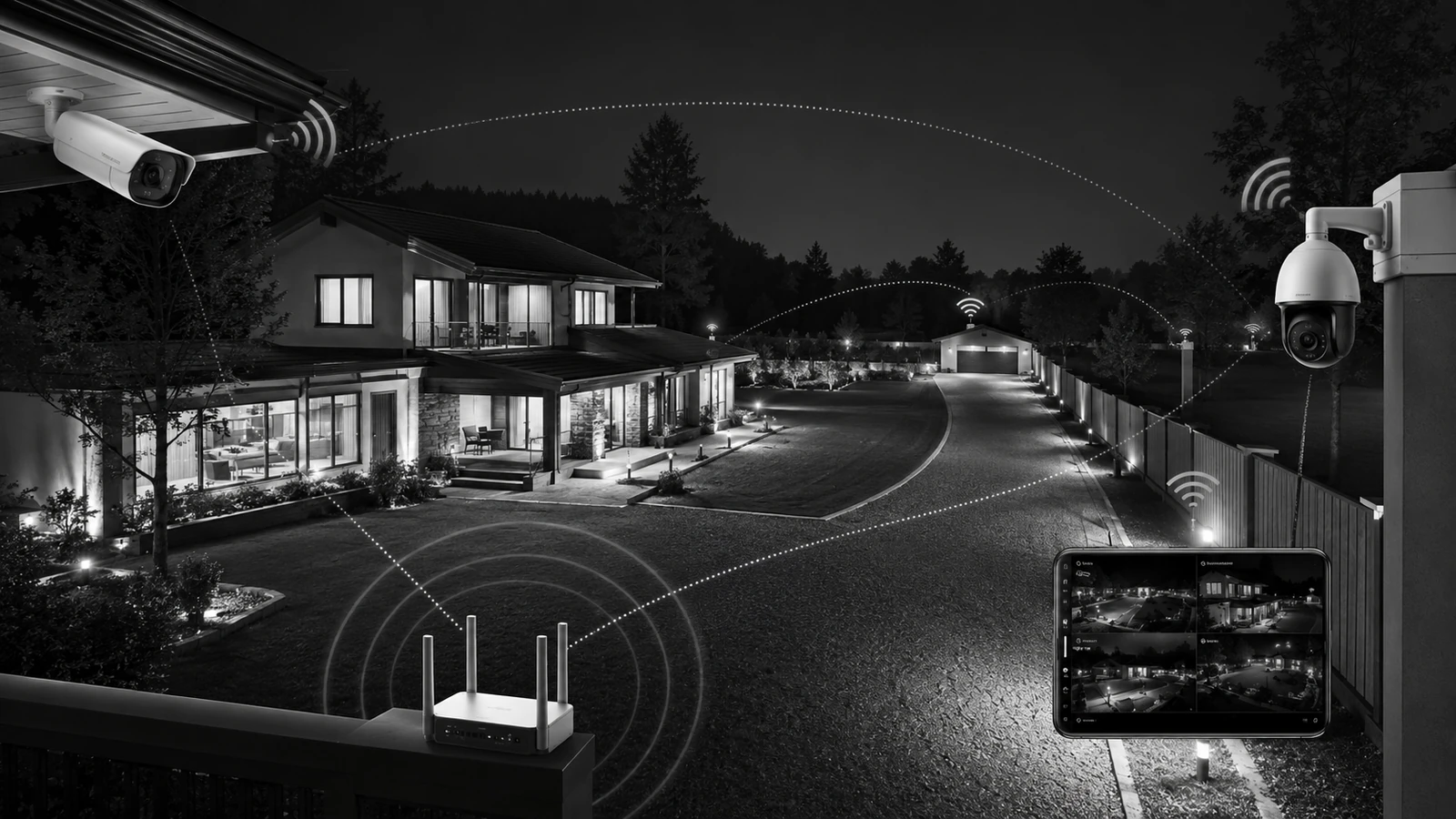
Best Long-Range Wireless Security Cameras in 2026
Finding the best long-range wireless security cameras is especially important when you need to monitor a large property, long driveway, detached garage, backyard, farm entrance, or another area located far from your main router. A camera can have excellent video quality, but if its wireless connection isn’t reliable at the installation point, those features won’t be much help.
The best long-range wireless security cameras combine strong wireless connectivity with useful features such as 2K or 4K video, night vision, motion detection, wide viewing angles, weather resistance, and dependable power options. Some systems also include their own NVR or monitor, which can reduce your dependence on a home Wi-Fi network.
For this guide, we’ve compared three systems designed with extended wireless coverage in mind. The 4K Solar Wireless Security Camera System with a claimed 2,300-foot long-range Wi-Fi connection is our Best Overall Long-Range Option, while the Blink Outdoor 4 XR is an attractive choice for buyers who want a simpler battery-powered system.
Important: Advertised wireless ranges are normally measured under specific conditions. Real-world range can be considerably shorter because of walls, concrete, trees, metal structures, interference, and router placement.
Disclosure: If you purchase a product through affiliate links on this website, I may earn a commission at no additional cost to you.
Quick Comparison
| Camera System | Resolution | Claimed Range | Power | Best For |
|---|---|---|---|---|
| 4K Solar Wireless System | 4K | Up to 2,300 ft | Solar + 11,600mAh battery | Best Long-Range Option |
| Blink Outdoor 4 XR | — | Up to 1,000 ft open air / 400 ft typical | Battery | Best Simple Wireless System |
| 5MP Wireless NVR System | 5MP | 55% longer range | Wired cameras + NVR | Best Complete NVR System |
What Makes a Wireless Security Camera Long-Range?
A long-range security camera isn’t simply a camera with a powerful antenna.
The actual wireless performance depends on several factors, including:
- Distance between the camera and receiver
- Walls and building materials
- Concrete and metal structures
- Trees and other obstacles
- Wi-Fi interference
- Router or NVR placement
- Camera antenna design
- Frequency band
- Network congestion
An outdoor camera positioned 300 feet from a router with a clear line of sight can perform very differently from one installed 300 feet away through several concrete walls.
That’s why the advertised range should be treated as a best-case figure, rather than a guarantee of the distance you’ll get at home.
How Far Can a Wireless Security Camera Reach?
There isn’t one universal maximum distance.
The three systems in this guide illustrate the difference.
The first system advertises a 2,300-foot long-range Wi-Fi connection, while the Blink Outdoor 4 XR lists up to 1,000 feet in open air and around 400 feet under typical conditions.
The third system claims 55% longer range and supports both 2.4GHz and 5.8GHz connectivity.
These numbers shouldn’t be compared as though they were measured under identical conditions. Different manufacturers can use different testing environments.
For the most reliable installation, place the receiver, router, or NVR as close as practical to the cameras and minimize physical obstacles.
Best Long-Range Wireless Security Cameras in 2026
1. 4K Solar Wireless Security Camera System
Best Long-Range Option
If your main priority is covering a distant location, this 4K solar wireless system is the most interesting option in this comparison.
The system advertises an impressive 2,300-foot long-range Wi-Fi connection, making it particularly appealing for large properties where conventional Wi-Fi cameras may struggle.
It also combines a built-in solar panel with an 11,600mAh battery, reducing the need for frequent charging when the camera receives enough sunlight.
The 4K resolution provides plenty of detail for outdoor monitoring, while color night vision can provide additional visual information after dark when lighting conditions allow it.
For motion detection, the system combines AI detection with PIR detection. This can help the camera respond to activity while reducing some unnecessary alerts.
The camera is also rated IP66 weatherproof, making it designed for outdoor exposure when properly installed.
There is no subscription requirement, which can be another advantage for homeowners who want to avoid recurring cloud-storage fees.
Pros
- 4K video
- Advertised 2,300-foot long-range Wi-Fi
- Built-in solar panel
- Large 11,600mAh battery
- Color night vision
- AI detection
- PIR motion detection
- IP66 weatherproof design
- No subscription required
- Suitable for large outdoor areas
Cons
- Actual wireless range depends heavily on installation conditions
- Solar charging depends on sunlight
- A very long advertised range shouldn’t be assumed through walls or buildings
Final Verdict
For buyers specifically searching for long-range wireless security cameras, this system stands out because of its advertised 2,300-foot wireless range combined with solar power and 4K video.
It’s particularly worth considering for large yards, long driveways, farms, detached buildings, and other locations where running cables would be inconvenient.
2. Blink Outdoor 4 XR
Best Simple Wireless System
The Blink Outdoor 4 XR takes a different approach. Rather than focusing on a large multi-camera NVR system, it is designed as a simpler wireless camera solution with extended-range connectivity.
The manufacturer lists up to 1,000 feet of open-air range or approximately 400 feet under typical conditions. That distinction is important because real properties contain walls, trees, buildings, and other obstacles that can reduce wireless performance.
The four-camera system is also attractive for homeowners who want to cover multiple locations around a property.
Another major advantage is battery life. The system is advertised with up to two years of battery life, although actual battery performance depends on settings, motion activity, temperature, usage, and other conditions.
For someone who doesn’t want to run power cables to every camera, this can make installation much easier.
Pros
- Four-camera system
- Extended wireless range
- Up to 1,000-foot open-air range
- Around 400 feet under typical use
- Advertised two-year battery life
- Wireless installation
- Good choice for multiple monitoring locations
Cons
- Real-world range can be substantially lower than open-air range
- Battery life varies with usage
- Best suited to buyers comfortable with the Blink ecosystem
- Some advanced features may require additional services or equipment
Final Verdict
The Blink Outdoor 4 XR is a good option for people who want longer wireless coverage without building a traditional wired camera system.
Its stated distinction between open-air and typical-use range is particularly useful because it gives buyers a more realistic idea of what to expect.
3. 5MP Wireless Security Camera System with 10-Inch Monitor
Best Complete NVR System
If you prefer having a dedicated recording system rather than relying entirely on cloud storage, this 5MP wireless system is worth considering.
It includes a 10-inch monitor, 10-channel NVR, four Wi-Fi cameras, and a 1TB hard drive.
The cameras use a 130° wide-angle view, which can help cover more of an area from each installation point.
The system supports 2.4GHz and 5.8GHz wireless connectivity and advertises a 55% longer range compared with its previous configuration.
Two-way audio is included, while the IP66 rating makes the cameras suitable for outdoor installation when properly positioned.
The 1TB hard drive also provides local recording without requiring a monthly subscription.
Pros
- 5MP cameras
- Four-camera system
- 10-channel NVR
- 10-inch monitor
- 1TB HDD
- 130° wide-angle view
- Dual-band 2.4/5.8GHz
- Advertised 55% longer range
- Two-way audio
- IP66 weather protection
- No monthly fee
Cons
- Requires more equipment than a simple standalone camera
- Wireless performance depends on installation conditions
- NVR requires a suitable location and power
Final Verdict
This system is a strong choice for homeowners and small businesses that want local recording, a dedicated monitor, multiple cameras, and expandable NVR capacity.
It’s particularly appealing if you want a more traditional surveillance setup without running PoE cables to every camera.
How to Improve Wireless Security Camera Range
Even the best long-range wireless security cameras can struggle if they’re installed poorly.
Here are some practical ways to improve connectivity.
Place the Router or Receiver Strategically
Don’t automatically put your router at the far end of the house and expect an outdoor camera to maintain a strong connection.
If possible, position the router, NVR, or dedicated receiver closer to the cameras.
Reduce Physical Obstacles
Concrete walls, metal structures, and multiple floors can significantly weaken wireless signals.
A clear line of sight is generally much better than forcing the signal through several dense walls.
Consider 2.4GHz for Distance
The 2.4GHz band generally travels farther and penetrates obstacles better than 5GHz, although it can be more susceptible to congestion.
5GHz can offer faster speeds but typically has a shorter effective range.
Some systems support both, allowing you to choose according to your environment.
Avoid Wireless Interference
Nearby routers, Bluetooth devices, wireless equipment, and other networks can contribute to interference.
If your camera frequently disconnects, checking the Wi-Fi environment may help identify the problem.
Use a Mesh Wi-Fi System When Appropriate
For a large home, a properly positioned mesh Wi-Fi system can help extend network coverage to areas that are too far from the primary router.
However, the camera must still be compatible with the network and receive a sufficiently strong signal at its installation point.
What to Look for in a Long-Range Wireless Camera
Wireless Range
Look at the manufacturer’s claimed range, but don’t treat it as a guarantee.
A range measured outdoors with a clear line of sight can be very different from the range through a house.
Video Resolution
For distant outdoor areas, higher resolution can be useful because it provides more detail.
4K cameras generally capture more detail than 1080P cameras, while 5MP cameras can also provide excellent resolution.
Night Vision
Long-range monitoring is only useful if the camera can provide usable footage after dark.
Look for infrared, color night vision, or a combination of both.
Weather Protection
Outdoor cameras should have appropriate weather protection.
The systems in this comparison include IP66-rated options designed for outdoor use.
Power
Power requirements matter even more when the camera is installed far away.
Solar and battery-powered systems can be particularly useful when running electrical cables would be difficult.
Local Recording
An NVR or local storage option can be valuable if you want recordings available without relying entirely on cloud services.
Where Should You Install a Long-Range Security Camera?
Long Driveways
A long-range camera can monitor vehicles approaching the property from a greater distance.
Large Backyards
Wide or distant areas can benefit from cameras with stronger connectivity and wide viewing angles.
Detached Garages
Wireless cameras can be useful when a detached garage is too far away for convenient cabling.
Farms and Rural Properties
Large properties often have areas that are difficult to reach with traditional wired systems.
Gates and Property Entrances
A camera positioned near a distant gate can provide an early view of approaching people or vehicles.
Frequently Asked Questions
What is the best long-range wireless security camera?
From these three options, the 4K Solar Wireless Security Camera System stands out for its advertised 2,300-foot wireless range, 4K video, solar charging, large battery, and outdoor weather protection.
How far can a wireless security camera reach?
It depends on the camera and environment. The products in this guide advertise ranges from several hundred feet to more than 2,000 feet under specific conditions. Walls, trees, concrete, metal, and interference can substantially reduce real-world range.
Does 2.4GHz or 5GHz have better range?
Generally, 2.4GHz provides greater range and better penetration through obstacles, while 5GHz usually offers higher speeds over shorter distances.
How can I make my wireless camera reach farther?
Improve the camera’s position, move the router or receiver closer, reduce obstacles, minimize interference, and consider a mesh Wi-Fi system where appropriate.
Are long-range wireless cameras good for large properties?
Yes. They can be especially useful for large yards, farms, long driveways, detached garages, and property entrances where running cables is difficult.
Does a long-range camera need internet?
Not necessarily. Some systems use a dedicated NVR or local wireless connection for recording. However, internet access is generally required for features such as remote viewing from outside the local network.
Final Verdict
The best long-range wireless security cameras should give you more than an impressive range number. The camera needs to maintain a reliable connection in the environment where you actually plan to install it.
🏆 Best Long-Range Option: 4K Solar Wireless System
With an advertised 2,300-foot Wi-Fi range, 4K video, solar charging, an 11,600mAh battery, AI and PIR detection, and IP66 weather protection, this is the strongest option for buyers prioritizing maximum coverage.
⭐ Best Simple Wireless System: Blink Outdoor 4 XR
The Blink Outdoor 4 XR is a good choice for users who want a simpler four-camera wireless setup. Its advertised 1,000-foot open-air range and 400-foot typical-use range provide a useful reference for what wireless performance can look like in different conditions.
⭐ Best Complete NVR System: 5MP Wireless NVR System
For buyers who want local recording, a 10-inch monitor, 1TB HDD, four cameras, and 10-channel expansion, this system offers a more complete surveillance setup.
Before buying, measure the distance between your planned camera locations and the router or receiver. Then consider the walls, buildings, trees, and other obstacles between them.
A camera advertised with an extremely long range isn’t necessarily the best choice if its signal can’t reliably reach your actual installation location.